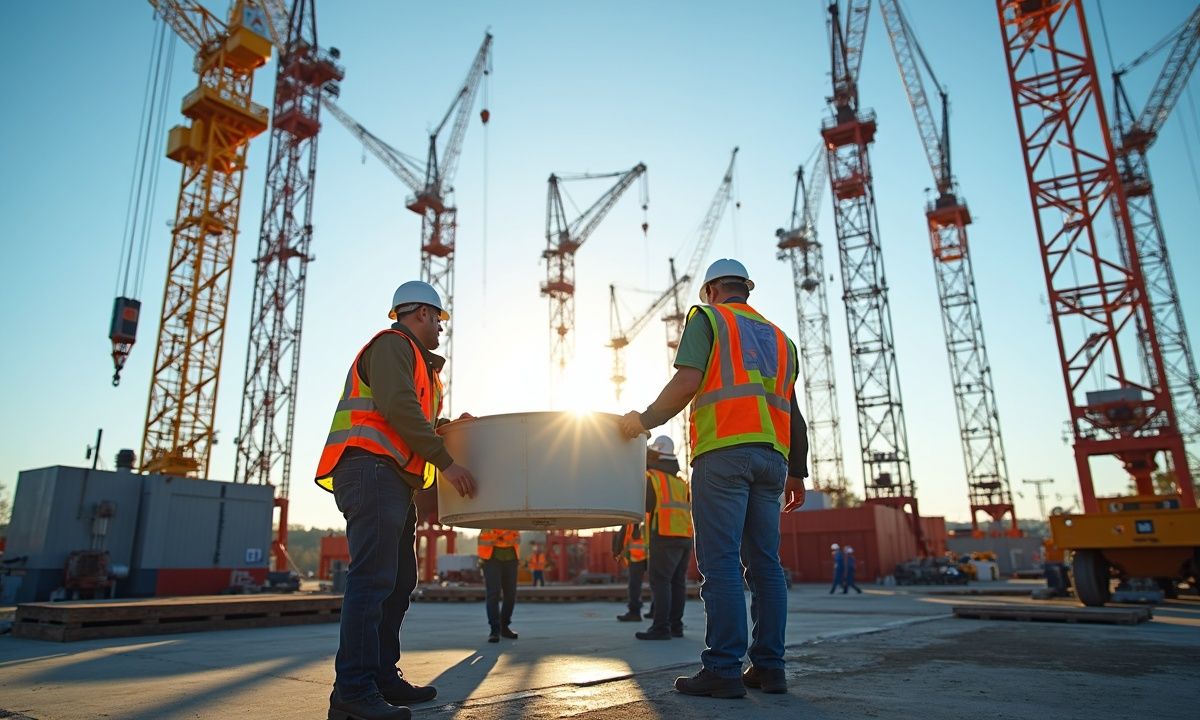
As the sun rises over the ITER project in southern France, the sight of construction crews diligently working on what could be the future of energy generation feels almost surreal. This ambitious endeavor aims to harness nuclear fusion, a process that mirrors the sun’s energy production. With the recent installation of vacuum chamber module no. 5, the project edges closer to its monumental goal. Nuclear fusion is increasingly viewed as a viable energy source that could reshape our approach to power generation, potentially offering a cleaner and more sustainable alternative to fossil fuels.
The Promise of Nuclear Fusion
Nuclear fusion holds immense promise. It involves fusing atomic nuclei to release energy, a process that could provide nearly limitless energy with minimal environmental impact. Unlike fossil fuels, which release carbon emissions, fusion produces helium as a byproduct, making it a far more environmentally friendly option. The ITER project represents a collaborative effort among 35 nations, aiming to create a prototype reactor that could lead to commercial fusion power plants.
ITER: A Global Collaboration
The ITER facility is not just a construction site; it is a symbol of international cooperation in the field of science. Countries from Europe, the United States, China, India, Japan, South Korea, and Russia are pooling their resources and expertise to tackle one of humanity's most pressing challenges: energy sustainability. This collaboration reflects a growing recognition that global issues require unified efforts. The installation of vacuum chamber module no. 5 is a significant milestone in this journey, demonstrating progress on a project that has been decades in the making.
The Mechanics of Fusion
Understanding how nuclear fusion works is essential in appreciating its potential. Fusion occurs when two light atomic nuclei combine to form a heavier nucleus, releasing energy in the process. In the case of ITER, the primary fuel is deuterium and tritium, isotopes of hydrogen. When these nuclei fuse, they produce helium and a neutron, releasing energy that can be captured to generate electricity. This mechanism, akin to what powers the sun, has the potential to provide a nearly inexhaustible energy source.
Challenges in Achieving Fusion
Despite its promise, achieving nuclear fusion is not without challenges. The conditions required for fusion are extreme, necessitating temperatures exceeding 150 million degrees Celsius—about seven times hotter than the sun’s core. Maintaining these conditions while containing the high-energy plasma is a complex task, often compared to trying to hold a star in a bottle. The ITER project utilizes powerful magnetic fields to confine the plasma, a method known as magnetic confinement fusion. The successful installation of vacuum chamber module no. 5 is a critical step in creating the environment necessary for these conditions.
Broader Implications of Fusion Energy
The implications of successfully harnessing nuclear fusion go beyond just energy production. It could significantly impact geopolitical dynamics, especially in regions reliant on fossil fuel exports. Countries that can develop this technology may find themselves at the forefront of a new energy era. The ability to produce energy without the carbon footprint associated with fossil fuels could also mitigate the effects of climate change.
Real-World Applications
While the ITER project is primarily focused on research and development, the potential applications of fusion energy are vast. A world powered by fusion could see advancements in various sectors, including transportation, manufacturing, and even space exploration. For instance, the high energy yield from fusion could enable more efficient propulsion systems for spacecraft, making interplanetary travel more feasible.

Moreover, as we grapple with the realities of climate change and dwindling fossil fuel resources, fusion energy could play a crucial role in transitioning to a more sustainable energy landscape. This transition is not merely theoretical; countries are already investing in research to develop practical fusion technologies. The optimism surrounding ITER echoes in the broader scientific community, where many believe that the technology could be commercially viable within the next few decades.
Public Perception and Future Prospects
The public perception of nuclear energy has been marred by historical accidents and the challenges of nuclear waste management. However, fusion presents an opportunity to shift the narrative. The safety profile of fusion is significantly better than that of fission reactors, as there is no risk of a catastrophic meltdown. Furthermore, the waste produced from fusion is far less hazardous and has a shorter half-life, making it easier to manage.

9-Second Visual Challenge Test Sharp Eyes by Spotting 3 Differences in the Boy Skiing Scene
As the ITER project continues to make strides, public interest and support for fusion energy may grow. Educational initiatives and outreach programs are vital in informing communities about the benefits and safety of fusion technology. By fostering a better understanding, the hope is to build a supportive environment for future advancements in the field.
Looking Ahead
The journey to achieving nuclear fusion is still ongoing, and the path is fraught with challenges. However, with each milestone, such as the installation of vacuum chamber module no. 5, the vision of a fusion-powered future becomes more tangible. The ITER project stands as a testament to human ingenuity and collaboration, as nations come together in pursuit of a common goal: a sustainable and clean energy future. The implications of this project extend far beyond the laboratory, potentially reshaping the global energy landscape for generations to come.
In an era marked by urgent climate concerns and energy demands, nuclear fusion is increasingly seen as a beacon of hope. The ongoing developments at ITER provide a glimpse into a future where energy is abundant and clean, allowing societies to thrive in harmony with the planet. As we watch the progress unfold in southern France, we are reminded of the power of collective effort in addressing the challenges that lie ahead.
For more insights into the advancements in nuclear fusion, read our article on Nuclear fusion is becoming less and less unattainable for the ITER project in southern France, which has just installed vacuum chamber module number 5. The potential of this technology is vast, and as countries continue to invest in research, the dream of sustainable energy may soon become a reality.
[SOURCES_START] World Nuclear Association|https://www.world-nuclear.org International Atomic Energy Agency|https://www.iaea.org SOURCES_END]
Comments (0)
No comments yet. Be the first to comment!
Leave a Comment